
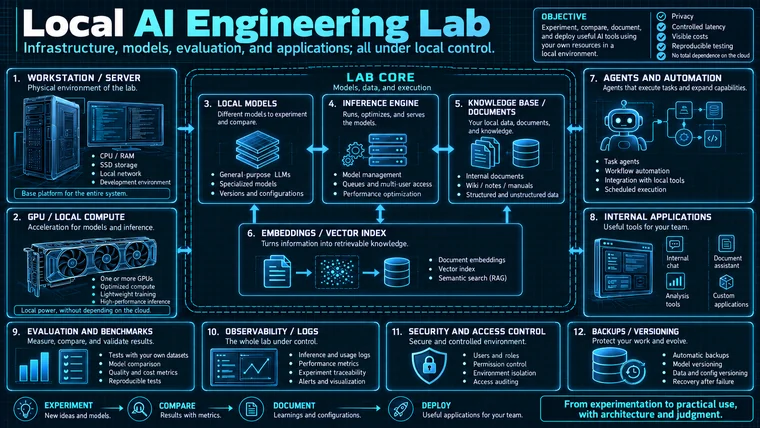
The impressive moment is brief: install a model, type a prompt, and watch an answer appear on your own machine. The engineering problem starts the next day. Can the experiment be repeated? Do you know which version produced the result, how long it took, which tool it called, what data left the machine, and where the workflow failed when the response stopped making sense?
That is where the job changes. Running a local LLM proves that inference works; building a local AI engineering lab means turning inference into a system that can be observed, reproduced, tested, and extended. That distinction became the organizing principle behind my public AI Engineering Lab: a practical route that starts with local models and ends with agents, retrieval, observability, interfaces, tests, and an MCP bridge to an external system. You may have seen this common problem before, but the difference here is the engineering lens. Here is the distinction: the model is one component; the lab is the system that makes its behavior inspectable and repeatable.
The point is not to argue that everything should run without the cloud. A more useful principle emerged from the work: complexity should earn its place. The experience became a practical guide, not a universal recipe.
Why does “local” not automatically mean “controlled”?
Serving a model from a workstation is already useful infrastructure. LM Studio, for example, can expose local models through REST and compatible API endpoints, making it possible to test applications without rewriting every client. Several sessions in the lab use Ollama for the same basic idea: put a stable API boundary around local inference.
But “local” is not automatically the same as “private,” “secure,” or “reproducible.” An agent may infer locally while still searching the web, calling an external API, or sending traces to an observability service. Model location is only one boundary in the system. The NIST Generative AI Profile for the AI Risk Management Framework makes the broader point: trustworthiness has to be considered across design, development, use, and evaluation—not inferred from where a model happens to run.
To be clear, running the model on your own machine solves only one part of the problem. So the lab was built around a different question: what would need to remain visible for the system to make sense tomorrow, not merely work today?
What makes a lab more than a folder full of demos?
The repository follows a deliberate progression. Before the agent sessions, an open-source LLM track covers LM Studio, Ollama, benchmarking, and RAG exercises. After that, each session adds one capability—and one new failure surface. The operating rule is simple: do not add an abstraction before you can name the problem it solves.
1. First step: start with a baseline that can fail understandably.
Session 1 reduces the stack to Ollama, a Python client, and a FastAPI service with /chat and /health. There is no agent team, persistent memory, or web research. If inference fails, the distance between symptom and cause is still short.
That simplicity matters. A stable baseline lets you measure latency, confirm hardware limits, and separate an infrastructure problem from an orchestration problem. The experiment stops being “the model answered” and becomes “the service responds under a known contract.”
2. Second step: add tools, state, and controlled execution.
Session 2 introduces an agent runtime with per-session memory, tools, and a small web interface. This is where a recurring lesson becomes concrete: a useful agent is not merely a prompt with a new label. It needs state, rules for tool use, and a controlled path back to the user.
Session 3 then adds a multi-agent flow with distinct roles. AutoGen research formalized this pattern: configurable agents can converse, use tools, and include human input to handle multi-step tasks. The value, however, comes from the interaction architecture rather than from the number of agents. Microsoft Research describes that model in the AutoGen paper.
That distinction matters because “more agents” can quickly mean “more places for the workflow to break.” In this lab, separate research, analysis, writing, and review roles make intermediate work inspectable. They are not proof that four models are inherently better than one. The same question appears in Do We Really Need Another Agent?: coordination cost has to be justified by the problem.
How does context become useful memory?
Session 3.4 adds persistent RAG with Postgres and pgvector, a quantitative layer, charts, and PDF generation. The conceptual shift is larger than the feature list suggests: part of the system’s knowledge moves from model parameters into retrievable memory that can be inspected and updated.
The foundational Retrieval-Augmented Generation paper by Lewis and colleagues explored the combination of parametric memory with an external retrievable source. This lab is not attempting to reproduce that research architecture; the practical lesson is simpler: when context matters, there should be a verifiable path for retrieving it.
The failures become more interesting too. For example, a PDF can break because a URL is too long, and a chart can exist on disk but still be unsuitable for a report. A writer can repeat material already present in the analysis; a RAG query can return too little context. Keeping those failures in the documentation is more valuable than polishing them away, because it shows where a demo ends and engineering begins.
Why does observability matter when “it worked” is no longer enough?
Session 4 builds a Research Operator without a private corpus, adding web research, a UI, and observability. The question is no longer just what answer the system produced, but what happened between the request and the answer: which node took time, which source was fetched, which fallback fired, and where a structured contract broke.
OpenTelemetry captures the general discipline well. Its semantic conventions define common naming for traces, metrics, and logs so telemetry can be correlated across components. The lab uses LangSmith or Langfuse in different sessions, but the principle is vendor-independent: a useful trace should let you reconstruct work, not simply confirm that something happened.
Session 4 also forces an uncomfortable engineering choice: scraping is fragile. HTML changes, blocking, CAPTCHA, and noisy pages require timeouts, deduplication, caching, normalization, and fallbacks. In many production cases, a stable API or a controlled corpus is a better foundation than an increasingly elaborate scraping pipeline.
What do you learn by keeping the same problem and changing the orchestration?
Session 5 keeps the Research Operator objective but changes the architecture to a dynamically created, AutoGen-style agent team. It adds query interpretation, role creation, turn-taking, strict budgets, and termination rules. Keeping the job constant while changing the orchestration makes the comparison architectural instead of cosmetic.
Session 5.1 is arguably more valuable because it keeps the difficulties. Its CrewAI variant uses strict JSON contracts and documents brittle parsing, fragmented configuration, inconsistent response shapes, and abstraction layers that complicate debugging. Several stages work, yet the repository itself does not recommend that specific design for production.
That record avoids a common AI-lab trap: treating a successful demo as proof of a winning architecture. A framework can complete the task and still be the wrong operational choice. That limitation is part of the lab history too.
What happens when the lab touches an external system?
Session 6 works as a capstone because it connects the pipeline to MetaTrader 5; it also adds an MCP server, deterministic gating, caching, and observability. MetaTrader provides an official Python integration for obtaining data from the terminal. In the lab, an EA also pushes market snapshots into the server so the pipeline can evaluate them on demand.
MCP contributes a different kind of boundary: a standardized contract for LLM applications to share context and expose tools. The current MCP 2026-07-28 specification describes hosts, clients, servers, resources, prompts, and tools; importantly, it also warns that these capabilities create data-access and code-execution paths that require consent, access controls, and careful tool handling.
That nuance matters. An MCP bridge does not make a workflow “agentic” by magic; it makes the workflow integrable. Reliability still depends on contracts, validation, permissions, limits, and execution evidence.
Five rules that survived the sessions: a design checklist.
After local models, RAG, agent teams, traces, and MCP, the lab did not produce a perfect stack. The key is preserving enough evidence to decide which complexity earns its place and which complexity only adds friction. The following checklist is a design guide, not a doctrine:
- Stabilize before you orchestrate. If the base endpoint is unreliable, agents only multiply uncertainty.
- Define contracts before adding autonomy. Inputs, outputs, state, and fallbacks should be visible before decisions are delegated to a model.
- Trace before debugging blind. Latency, tool calls, errors, and intermediate outputs need a reconstructable history.
- Evaluate on your own tasks. General benchmarks can orient a decision; reproducible tests on real work determine whether the system is useful.
- Make complexity pay rent. RAG, agents, tools, and MCP should remove a specific constraint. If they only add layers, they also add debt.
What can a local lab give you—and what can it not?
A local environment can provide more control over the runtime, reproducible experiments, and visible compute costs. It can also keep selected data inside infrastructure you operate, compare models under known conditions, and preserve artifacts, configurations, and tests.
It does not guarantee confidentiality when the workflow calls external services, nor does it remove the need for security, evaluation, or governance. A local model can hallucinate; a tool can fail; an integration can expose more data than intended. The value of the lab is precisely that those boundaries can be made visible.
That is why the blueprint accompanying this article does not stop at the GPU. It includes models, inference, documents, indexes, agents, applications, benchmarks, logs, security, and backups. The workstation is the hardware; the lab is the evidence system built around it.
Want to check it? You do not have to believe it.
The repository keeps code, roadmaps, READMEs, smoke tests, and failure notes from the baseline through the Trading Desk. That history can be followed in sequence, opened at one specific session, or used as a reference for questioning another architecture.
Explore AI Engineering Lab on GitHub. If one session proves useful, the best outcome is not copying its stack; it is being able to explain what problem every layer solves and what evidence would show that it still deserves to be there.