
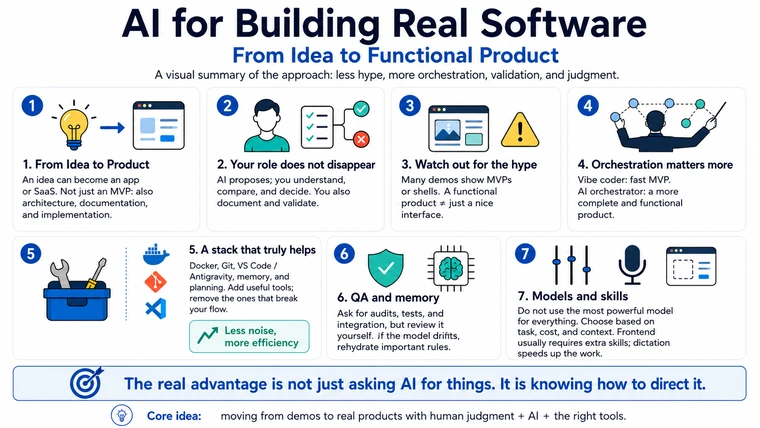
A few years ago, many software ideas could spend months trapped between a notebook and a spreadsheet. They often sat behind a vague promise to build them someday. Today, if you work with AI, your idea can travel that distance much faster. Models reason about code, agents use tools, and development environments connect more stages of the work.
That speed changes what feels possible in your project; it also changes which problem you need to define and which result you can responsibly accept. In my own projects, that has become the useful dividing line: seeing an application appear quickly does not mean you already have a product.
AI can help explore an architecture, propose a data model, write an API, build an interface, generate tests, inspect errors, and document decisions. But producing more code does not remove judgment; it shifts my attention toward correct behavior and the evidence required to accept the result.
The difference may sound small, but it reorganizes the rest of the process: using AI to produce software is not the same as using AI to build something we can responsibly sustain.
A working demo can still be far from ready
There is something compelling about watching an application appear in minutes. You write an instruction; the model generates components, connects a database, and creates a few routes. Suddenly there is something you can open in a browser. If the interface also looks polished, the sense of progress is enormous; and it is progress, there is no reason to dismiss it.
For example, a prototype can validate a hypothesis, make a workflow visible, or support a conversation that previously existed only in the abstract. An MVP may also be exactly what an early stage requires. The problem begins when we confuse being able to demonstrate something with being ready to put it in front of real users and be accountable for its behavior.
Operating for real users requires different guarantees: consistent data, permissions that actually constrain access, states that do not contradict one another, and errors that do not destroy the workflow. A repeatable deployment path and a way to recover when something breaks matter too; so do tests, security, traceability, and enough observability to reconstruct what happened.
In other words, the gap is not simply a matter of adding more features. It is the move from showing that something can work to demonstrating that it can work under real conditions. A demo can hide a great deal of complexity until permissions, failures, and recovery begin to matter.
This helps explain why some “I built a complete SaaS with AI in an afternoon” videos can be impressive while still showing only part of the journey. The demonstration may be entirely legitimate; the remaining question is what has to happen before it becomes reliable, maintainable, and operable.
AI changes the distribution of effort; it does not remove the development lifecycle
The DORA 2025 research on AI-assisted software development describes AI as an amplifier. It magnifies strengths and weaknesses in the working system already in place. I find that framing useful because it avoids two extremes: the tool does not repair a weak development process by itself, yet treating it as faster autocomplete also misses the scale of the change. DORA does not prove that AI improves every project; it supports a more careful point: much of the effect depends on the system surrounding the technology.
As implementation accelerates, the relative weight of different tasks shifts. Producing an initial version may become cheaper; defining correct behavior, preserving context, reviewing decisions, and verifying outcomes can become proportionally more important. Code generation does not make those activities disappear: it moves them closer to the center of the work.
So I no longer think about the path as simply “idea → code.” A more useful sequence follows.
idea
→ problem
→ criteria
→ architecture
→ implementation
→ tests
→ audit
→ correction
→ deployment
→ observation
→ feedback
→ improvement
AI can participate in almost every stage; what matters is that not every stage depends on the same kind of reasoning or the same source of truth.
More speed requires stronger ways to inspect and reverse change
Working with AI without control mechanisms quickly becomes fragile. The faster an agent can modify a system, the more important it becomes to know what changed, compare states, reproduce results, and return to an earlier version when necessary.
Git, isolated environments, containers, automated tests, continuous integration, and change review become no less relevant when agents enter the workflow; they give those agents a safer surface on which to operate.
GitHub’s guide to reviewing AI-generated code recommends beginning with automated tests and static analysis, then checking whether the change actually fits the project’s purpose, requirements, and architecture. The second part matters enormously: code can compile and pass existing tests while still solving the wrong problem.
A practical rule follows: the higher the generation speed, the stronger the inspection and rollback capability should be. This matters because any tool capable of producing many changes quickly can scale a poor decision just as quickly; AI has no special exemption from that dynamic.
As a project grows, preserving intent becomes part of the architecture
In a small project, many decisions can live in your head: why a certain structure was chosen or which part should remain untouched. You also remember recent exceptions and behavior that is still undocumented. With agents, that model stops scaling very quickly.
A model does not share our decision history or know which conversation contains a critical constraint. If the project depends on that knowledge, it has to become retrievable: specifications, examples, contracts, documentation, tests, rules, decision records, or useful memory.
This connects directly with AI Does Not Eliminate Engineering; It Forces Engineering to Become More Explicit: as we delegate more execution, decisions that could once remain implicit have to become observable criteria.
A specification then stops being a document written at the beginning and forgotten; it becomes an interface between intent and execution. Memory changes function as well: I do not need a system to remember “everything,” only the information that could alter a future decision.
That boundary matters because too many instructions, stale documentation, or irrelevant memory can make a system as difficult to govern as insufficient context. The useful criterion is not how much we can store, but which information deserves to remain active and why.
Security and quality have to enter before the application “works”
I also stopped treating security, quality, and maintainability as a final inspection that begins after the interface already responds. NIST’s Secure Software Development Framework argues for the opposite. Secure development practices should be integrated throughout the lifecycle rather than attached at the end as a patch.
That principle fits agent-assisted development particularly well. If a feature can appear in minutes, discovering a broken permissions model, an exposed route, or an architectural decision that makes a critical flow almost impossible to test becomes even more expensive when found late.
I prefer controls to enter while the system is being built: tests for objectively verifiable behavior, automated validation for clear rules, focused review for high-risk changes, and human approval when impact or uncertainty justifies it.
AI can help create and execute many of those controls; it should not be the only authority deciding whether its own result is acceptable.
Orchestration means coordinating decisions, not accumulating agents
The word “orchestration” is often associated with several agents working in parallel; to me, that definition is too narrow. Orchestration means deciding what work should happen, in what order, with what context, through which tool, under which constraints, and with what evidence at the end.
Sometimes that will require multiple agents; in other cases one agent, good tools, and deterministic software are enough. In Do We Really Need Another AI Agent—or Should the System Know This Already? I explored that boundary directly: if a decision is stable, repeatable, and objectively verifiable, it may belong in the system instead of being reasoned through again on every run.
OpenAI’s practical guide to building agents points in a compatible direction: start with strong foundations, provide clear tools and instructions, and use guardrails. It also preserves a role for human intervention, especially around repeated failures or high-risk actions.
The principle I take from that is simple: orchestration is not about maximizing autonomy; it is about assigning autonomy where it creates value and constraints where they reduce risk.
AI can audit too; acceptance still needs an external reference
The same AI that implements can contribute to review by proposing tests, searching for inconsistencies, comparing files, analyzing logs, or suggesting scenarios we had not considered. A second model or a separate agent can also bring another perspective and reduce dependence on a single context.
That helps enormously, but it does not solve governance by itself. If acceptance means only that the agent reports completion, the definition becomes circular. We need something outside that declaration against which to compare the result: a test, contract, requirement, simulation, known data, human review, or a combination of those forms of evidence.
In engineering, accepting a deliverable did not mean simply asking the contractor whether the work was finished. There were drawings, specifications, tests, punch lists, and closure criteria; AI-assisted development deserves the same discipline, even when many of those activities can now happen much faster.
This is why I find it useful to separate two verbs: generate and accept. AI can generate a great deal; acceptance still means demonstrating that the result satisfies what matters.
The skill gaining importance is directing the working system
The most interesting shift is not that I can request code without writing every line; it is that a growing share of the work moves toward higher-level decisions.
We have to know when to explore and when to consolidate; when an implementation deserves another iteration and when the problem itself is poorly defined. We also need to distinguish whether the right move is changing the model, changing the tool, or correcting something more basic: the specification. Above all, someone still has to decide what evidence is sufficient to move forward.
That work requires technical judgment, although not exactly the same judgment that dominated when manual implementation consumed most of the time. The combination increasingly includes architecture, requirements, domain knowledge, tool use, evaluation, QA, security, and the ability to stop the process when something “works” but is not yet good enough.
It is not simply prompting; it is AI-assisted technical direction.
Before calling what we built a product, I would use seven questions
No universal checklist can declare every piece of software ready. Still, these seven questions help me distinguish a promising demonstration from something beginning to behave like a product:
-
Does it solve the right problem? A function operating correctly does not mean it addresses the real need.
-
Is the important behavior specified? Especially permissions, states, errors, limits, and exceptions.
-
Can I demonstrate that critical behavior works? Not only through a conversation, but through tests, data, contracts, or observable evidence.
-
Do I know what changed, and can I go back? Versioning, traceability, and rollback become essential as speed increases.
-
What happens when something fails? A system is also defined by how it degrades, recovers, and communicates errors.
-
What requires human review? Some decisions can be automated; others need an explicit gate because of impact or uncertainty.
-
What will we know after deployment? Logs, metrics, feedback, and observability turn real usage into information for the next iteration.
If I cannot answer several of these questions, I may still have something valuable; I simply would not consider it ready to carry the responsibilities of a product.
The distance from the idea is shorter; direction matters more
AI has reduced a barrier that kept many ideas away from software for years: the cost of translating intent into an initial implementation. That creates enormous possibilities for people who understand a problem deeply even if they have not spent their careers writing code.
Lowering that barrier does not remove the others; it changes their relative importance. Architecture, security, specifications, testing, tooling, context, auditing, and human judgment remain, and in many projects they become the real bottleneck.
With that shift in perspective, I am no longer impressed only by how quickly AI can build something. I am more interested in a harder question: can that speed become a system that remains understandable, verifiable, and maintainable when it starts having real consequences?
That is the important transition. AI shortens the path from idea to first version. Engineering, orchestration, and validation decide whether that speed can become something other people can trust and we can sustain.
References
- DORA — State of AI-assisted Software Development 2025: AI as an amplifier of strengths and weaknesses in the surrounding working system.
- GitHub Docs — Review AI-generated code: automated testing, static analysis, and review of context, requirements, and architecture.
- NIST — Secure Software Development Framework (SSDF) Version 1.1: secure software practices integrated into the development lifecycle.
- OpenAI — A practical guide to building agents: tools, guardrails, architectural simplicity, and human intervention.