
RHYMING PICTURE BOOK · AGES 3–5
Lenny the Little Sea Lion Learns Kindness
A little sea lion, a collection of treasured shells, and friends who keep asking him to come play
On a shore inspired by the Galápagos Islands, Lenny is perfectly happy with his shells. He finds them, arranges them, and keeps the special ones close while Iggy, Tula, and Pico keep calling him over to play. It is a small beginning with a feeling many young children recognize: wanting to protect what feels like yours while still figuring out how much room to make for someone else.
That is where a story can make the idea clearer and easier to explore. A sample question can be as simple as, “What do you think Lenny will do?” You and your child have a character to watch and a choice to wait for, instead of beginning with “you should share” or “be kind.”
Lenny the Little Sea Lion Learns Kindness: A Rhyming Tale of Sharing and Friendship is an illustrated English-language story designed for ages 3–5 and inspired by the wildlife and volcanic shores of Ecuador's Galápagos Islands. It spans 32 illustrated pages and is currently available on Kindle. The “Let's Talk” section adds sample conversation starters and simple activities for parents, caregivers, and teachers who want them.
If you need a rhyming read-aloud that your child can enjoy in the moment and that may later give you a clearer way to talk about kindness, empathy, sharing, and friendship, Lenny offers a memorable place to begin.
Meet Lenny on Kindle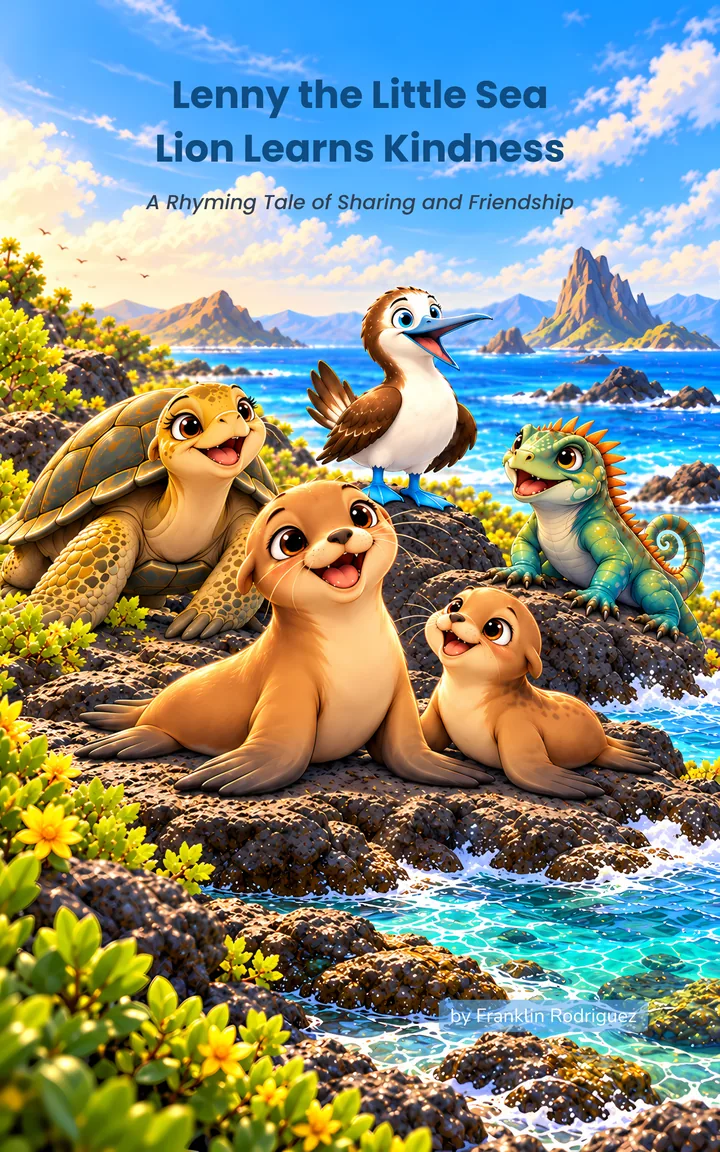
A Galápagos-inspired world that gives children more to notice
Lenny's coast has turquoise water, warm sand, volcanic rock, tide pools, and animals inspired by one of Ecuador's most distinctive places. The setting gives the story its own visual identity while keeping the emotions simple enough for a preschooler to follow.
Alongside Lenny are Iggy, a marine iguana; Tula, a calm and observant tortoise; and Pico, a blue-footed booby whose bright feet are hard to miss. For example, one child may be fascinated by Pico, another may keep returning to Iggy, and another may simply want to count the shells.
Which part would catch your child's attention first: the animals, the rhyme, the shells, or the way the friends respond to one another? You do not need to know in advance. Each detail offers a different doorway into the same small world, and the illustrations can also invite curiosity about Ecuador, the Galápagos, and wildlife that appears less often in children's picture books.
Rhyme gives the read-aloud a reason to keep moving
Across 32 pages, the story unfolds in short four-line rhyming stanzas. The rhythm creates continuity and anticipation, giving a young listener sounds and patterns to recognize while the adventure moves forward.
Picture the next bedtime or quiet afternoon. Your child starts anticipating a rhyme, recognizes a familiar face, or points to Pico before you finish the page. You can simply keep reading, or you can pause for one question: “Which part seems to matter most to Lenny right now?”
The story shows kindness through actions, feelings, and choices rather than long definitions. For example, an expression in an illustration may be enough to begin a conversation about worry, friendship, or empathy. On another day, no question may be needed at all; the rhyme and the characters can carry the reading on their own.
The next time a real-life moment involving sharing, waiting, helping, or repairing a mistake becomes difficult, you will already have a character both of you know. Weeks later, one small reminder may be enough to bring the story back.
Sharing can be generous without meaning “give away everything you love”
Lenny's story leaves room for a useful distinction: children can care about their belongings, keep something special, and still learn to make room for other people. Kindness does not need to erase personal boundaries.
Sharing can mean taking turns, inviting someone to play, listening, helping, saying thank you, apologizing after a mistake, or staying close when a friend is worried. The story gives children examples they can watch, which means the idea can stay connected to characters and feelings rather than becoming a rule to repeat. A sample moment in the story can be enough to start a much smaller conversation at home.
That makes room for conversations about kindness, empathy, friendship, sharing, boundaries, gratitude, apology, repair, and belonging. If what matters to you is a story that lets a character make a mistake without becoming “the bad one,” Lenny may fit especially well. Growth comes from what he notices and what he chooses next, not from a label placed on him.
Story first. The SEL conversation is there when you want it.
The Kindle edition includes a “Let's Talk” section with sample conversation starters and simple activities. You can use one, review a favorite illustration with your child, save another sample activity for later, or simply read from beginning to end.
For example, you might ask which friend your child liked most, why Lenny seems to care so much about something, or what another choice could look like. In a preschool or classroom, the same story can support read-aloud or circle time without requiring a formal lesson plan.
If you are looking for a social-emotional learning (SEL) picture book, that balance may matter for you. First come characters, rhyme, curiosity, and a small adventure. If a conversation follows, you already have a shared reference point; if it does not, your child still has a story to enjoy.
If you need a formal SEL curriculum, a workbook, or a Spanish-language edition, this Kindle may not be right for you. It is an English-language picture book with optional prompts that adults can use when they fit the moment.
A shared reference beyond storytime
Imagine a future moment when waiting is hard, a treasured object suddenly feels too important to share, or a small mistake needs repair. You do not need to begin with a long explanation. You can return to someone both of you already know and ask, “Do you remember Lenny?” That question leaves room for your child to think. You can ask what seemed important to Lenny, which part felt difficult, or what another choice might look like in your child's case. The answer may take a minute, or the conversation may return weeks later.
When you need a familiar way into one of those conversations, a shared story can be easier to reach for than an abstract definition. In your case, the most useful connection may be completely different from the one another family notices, and that is part of what makes reading together personal.
Lenny may fit especially well if you are looking for…
Lenny is designed for ages 3–5 and may be a strong fit when you need:
- A kindness picture book for preschoolers.
- A rhyming animal story for bedtime, read-aloud time, preschool, or classroom circle time.
- A sharing-and-friendship story that also respects personal boundaries.
- A social-emotional learning book with room for empathy, gratitude, apology, repair, and belonging.
- A Galápagos-inspired picture book featuring a sea lion, marine iguana, tortoise, and blue-footed booby.
- An English-language Kindle story with a bonus section of sample questions for adults.
Kindness ripples. Friendship grows.
Imagine the next time you open the Kindle. Your child recognizes Lenny, starts anticipating the rhyme, and points to Pico before you finish the page. You keep reading. Later that evening, or perhaps several weeks from now, a moment involving friendship, sharing, helping, or repair appears outside the story.
Now you have a character to return to. You'll be able to ask one small question and notice where your child takes it, without needing a speech or a prepared answer.
What matters to you when you choose a read-aloud: a story your child can enjoy now, a world that feels different from the usual animal cast, or language you can return to when a real conversation appears? Lenny brings those possibilities into the same short Kindle experience without requiring each one to happen every time.
If that sounds like the kind of story you want nearby for the next bedtime, quiet afternoon, or preschool read-aloud, Lenny is ready for your next reading moment.
Read Lenny the Little Sea Lion Learns Kindness on KindleThe book is written in English and is currently available on Kindle.