
In real-world electrical design, the input changes daily. Sometimes you have kVA from a transformer sheet. Other times, it's just current from a clamp meter. Relying on fixed, one-way calculators—or fragmented spreadsheets—introduces risk and unnecessary time sink.
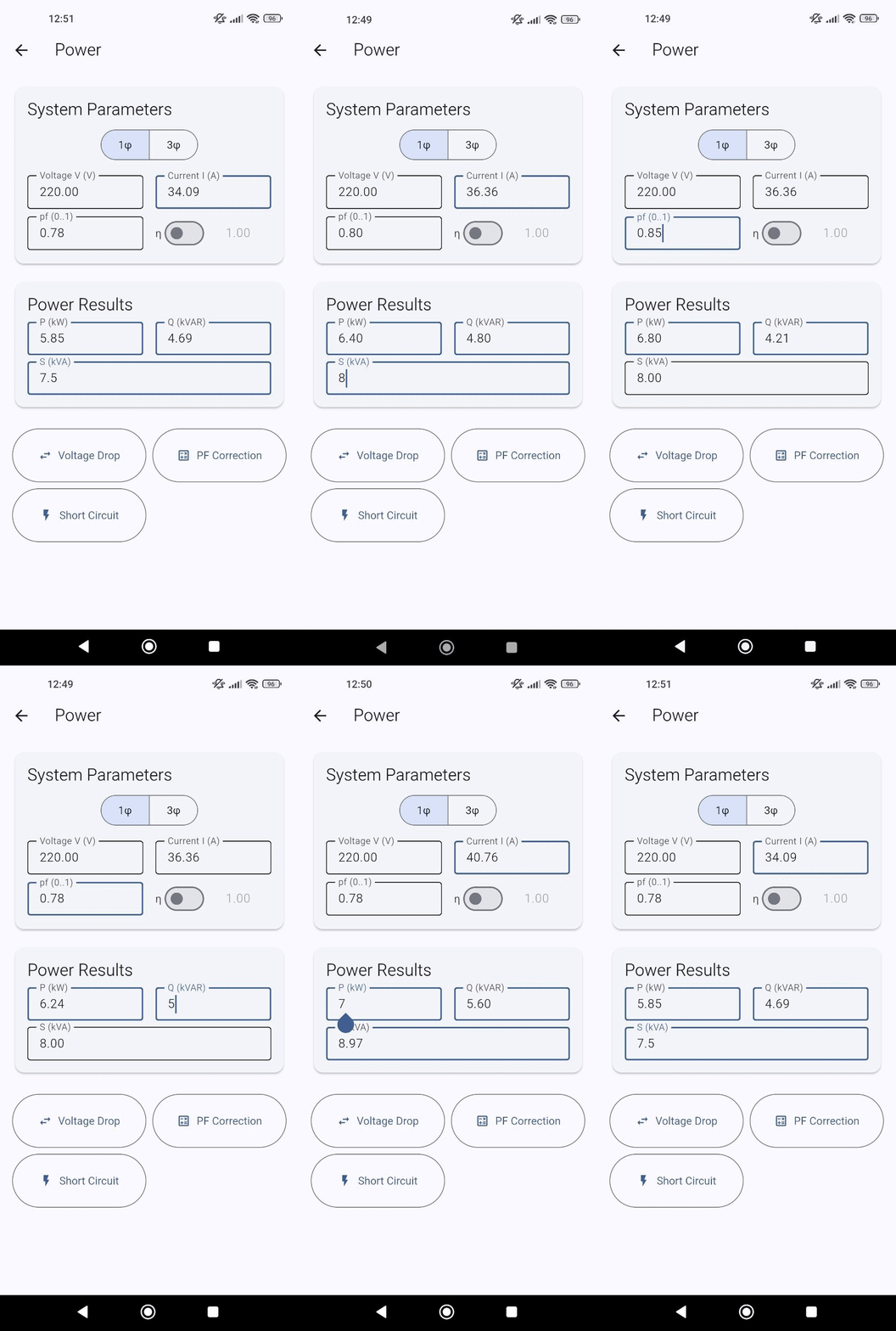
This article introduces a workflow where a professional tool, like WattsWise, acts as a dynamic AC circuit solver: change any variable (kW, kVAR, kVA, PF, V, I) and the entire power triangle rebalances instantly. It's the only way to maintain data coherence when reviewing load calculations.
The Engineering Pain Point: When Formulas Fragment Your Workflow
The fundamental issue with most online tools and custom Excel sheets is their unidirectional nature. They are built around a single, specific calculation path (e.g., V + I + PF → compute kVA). This fails to mirror the reality of site assessment and design review, where:
- You are given a desired power factor and a measured real power (kW), and must solve for required kVAR.
- You have a transformer’s kVA rating and the system voltage, and need to quickly find the maximum current (I).
- You've measured kVAR (from a capacitor bank) and kW (from a utility bill) and need the resulting kVA and PF.
To solve these varied scenarios with traditional tools, you must either:
- Open a different online calculator (risking unit and formula inconsistency).
- Create multiple sheets or complex conditional logic in Excel (leading to fragile, unmaintainable workbooks).
- Waste time with Excel's slow Goal Seek feature, manually iterating toward a solution.
Understanding the Power Triangle: P, Q, S and the Cosine of the Angle
The power triangle visually represents the relationship between the three core components of AC power, forming a right-angled triangle. This is the vector sum of power in a circuit.
- Real Power (P, kW): The power that actually performs work (e.g., heat, mechanical rotation).
- Reactive Power (Q, kVAR): The power needed to establish the magnetic fields required by inductive loads (motors, transformers). It does no work but must be supplied by the utility.
- Apparent Power (S, kVA): The vector sum of P and Q. It represents the total load on the source/utility.
The Power Factor (PF), defined as PF = cos(φ) = P/S, is the efficiency of power utilization. The closer PF is to 1.0, the smaller the reactive component (Q) is relative to the real component (P).
Core Electrical Formulas (The Physics of Power)
These foundational relationships govern the entire workflow:
S = V · I
P = S · PF
Q = √(S² − P²)
S = √3 · V · I
P = S · PF
Q = √(S² − P²)
PF = P / S
S  = √(P² + Q²)
I(3φ) = 1000·S(kVA) / (√3·V)  <-- Essential for feeder sizing
I(1φ) = 1000·S(kVA) / V
The Solution: Dynamic, Bidirectional Rebalancing
The key to a high-density, professional workflow is a system that enforces coherence using the above formulas, regardless of which variable you enter.
WattsWise allows you to edit any variable — not just P, V, or I. The complex algebra engine instantly re-solves the entire triangle and related values (like current, I) in real-time. This eliminates the risk of human transcription errors and ensures the system voltage, current, and power components are always mathematically consistent.
Incorporating Efficiency (η): The Realism Switch for Load Calculation
For loads like motors and mechanical equipment, the measured output power (the mechanical work done) is not the same as the electrical input power. Efficiency (η) accounts for internal losses (heat, friction).
In a true engineering context, when efficiency is below 100% (η < 1), the required electrical input power must be higher to achieve the necessary mechanical output. WattsWise enables this realism by adjusting the electrical input power Pin based on η:
P_in,adjusted = P_in / η
(Required electrical input power increases as η decreases)
This adjusted input power (Pin,adjusted) then correctly propagates into the resulting kVA, kVAR, and, crucially, the required current (I). Ignoring efficiency can lead to undersizing conductors or protective devices.
The Bottom Line: Professional Tools vs. Fragmented Solutions
Calculating P/Q/S is simple algebra. The true bottleneck in engineering work is the context switching: re-entering values, managing data flow between disparate tools, and verifying continuity.
The professional solution is a tool built with an intelligent, interconnected core. Don't let a change in a single value force you to repeat an entire sequence of calculations or risk misapplying a fragile Excel formula.
If your daily work requires dynamic, responsive analysis—from field measurements to final panel sizing—you need a solution built for data coherence. Explore WattsWise and let the power triangle rebalance itself with engineering-grade precision.